Life, art, bitch-slapping the media jackals (4/25/00)
____________
Paul Newman [as Governor Earl Long] addresses his dick in his best Louisiana accent for the benefit of Lolita Davidovich: “Come on now! you on the state payroll...now wake up!” — “I’d fire the damn freeloader if I could,” he explains. I’ll bet he would.
Scream Three. [Wes Craven, 2000; written by Ehren Kruger.]
About halfway through this third and [we are repeatedly assured] final chapter of the franchise that made Kevin Williamson a multinational conglomerate, heroine Neve Campbell takes a wrong turn on her way out of the studio restroom and finds herself exploring the deserted soundstage on which the cast and crew of [a cough behind the hand]
Stab Three are filming the conclusion of a slasher trilogy based upon her own real-life adventures — or were, until someone began hacking up the actors — and, with a mounting sense of relived horror and ever louder voices in her head whispering dialogue from the previous episodes, wanders dumbstruck through sets that reproduce with uncanny accuracy the hometown scenes on which mysterious and seemingly superhuman masked psychopaths with large knives stalked her in North Carolina far away, in a past she seemingly cannot escape — and, incidentally, what’s that noise? is someone...following her? — The real joke here, of course, is that the movie sets depicting the “real” town of Bayboro
are the real town of Bayboro, not eerie doppelgängers — not reality depicted, but depiction as reality — and that Neve is actually a scream queen pretending to be a real person dismayed to discover that a masked slasher is following her around the soundstage on which a scream queen has been pretending to be Neve in peril from a masked slasher. [I think I have that right.] — This is either right before or right after Carrie Fisher turns up in the studio dungeons bitching about getting shafted out of the part of Princess Leia because she wouldn’t fuck George Lucas, and right about the time that it sinks in that David Arquette and Courteney Cox really did fall in love during the shooting of the original
Scream and now really are married and that the halting problem is provably unsolvable for a universal Turing machine because you can program it to emulate itself. — At this point, however, two paths diverged in the scriptwriter’s wood, and the one that led to a grand surreal conclusion in the classic style of
Blazing Saddles [and a review that would only be expressible in the lambda calculus], was, alas, the one not taken; instead [I reveal no secrets of real consequence] after casting a certain amount of suspicion on everyone in sight the culprit is revealed to be...the Evil Twin!!! [well, almost], and the climactic battle in [how very] a screening room begs interpretation as an argument over Final Cut. — But you don’t need me to tell you that this movie could have been better; you have Ebert for that. Suffice it, instead, that it is not without charm; that it is directed by one of the great masters of the genre; that the serial victims of the mad slasher [Lance Henriksen, Jenny McCarthy, and Parker Posey, among others] take their falls with great good grace; and that the cameo by Jay and Silent Bob is actually pretty cute. — After all, so long as Kevin Smith is taking the studio tour in someone else’s movie, he’s not making one of his own.
Eye Of The Beholder. [Stephan Elliot, 1999.]
An essay in the evergreen stalker genre: master spook and technopeeper Ewan McGregor, tracking the errant son of a government bigshot to a fatal assignation with woman of mystery Ashley Judd, is stricken by her indefinable fascination; trailing her by plane, train, and automobile from one city to the next, he accumulates much grainy pseudosurveillancecam footage of the Object of Desire getting into and out of hotel bathtubs and bears witness to her numerous whackings of feckless dickheads who seem [conveniently] to deserve their fate — all the while seething inwardly at the dark unnameable desires which draw him ever onward into an obsessive whirlpool of forbidden cinematographic quotes from
Vertigo. — Now, obviously: if he doesn’t follow her [quite literally] to the ends of the Earth there is no movie; and, therefore, he must. But the rationalization for this behavior, which has something to do with Ashley’s taking the place of Ewan’s invisible companion/longlost daughter, and he in turn replacing her guardian angel/longlost father, is completely incoherent: chemical bonds work like this; human bonds do not. — Ms. Judd however does a great Kim Novak, and the locations are excellent: Washington, New York, Boston, Pittsburgh, Chicago, San Francisco, the great American desert, Alaska; and never a hint of Los Angeles.
Twin Falls Idaho. [Mark and Michael Polish, 1999.]
A hooker with a heart of gold falls for a pair of Siamese twins. Incredible. — With Michele Hicks as the lady of the evening, Jon Gries, Garret Morris, William Katt, and Lesley Ann Warren as members of the dramatic chorus, and the auteurs themselves in the suit with three legs. Check this out.
Magnolia. [Paul Thomas Anderson, 1999.]
“And so it goes,” muses the narrator toward the end of the third hour of this wonderfully complex and wholly remarkable motion picture; “and so it goes.” A dead giveaway; but the observant viewer will have noted long before this the influence of Kurt Vonnegut upon the structure of the narrative — which follows, in essence, the fortunes of the several members of a Bokononist karass — a group of persons whose lives, should they glimpse the scheme or not, are intertwined by the machinations of an unknowable fate [or the complexities of an unseen narrative] — through an eventful [and, nota bene, a rainy] day in Anderson’s native milieu, the San Fernando Valley. Vonnegut, of course, was a sort of comedian; Anderson is rather more a tragedian, and, therefore, the thematic similarities that link the fortunes of the members of the ensemble — which includes present and former child stars of a television quiz show [compare J. D. Salinger], the show’s asshole MC, the MC’s selfdestructive daughter, a dying producer, his emotionally disturbed [second] wife, his geek male nurse, the charismatic but unbalanced organizer of selfimprovement seminars that teach wouldbe sexual predators how to seduce and destroy, a bungling lonely-guy policeman, and a preadolescent rapper — are the varieties of misery: drug addiction, child abuse, cancer, a selfobliterating desire not simply to deny but to annihilate the past, adultery and gnawing guilt, incontinence, vomiting, the sense of lost opportunity and wasted talent that haunts the failed Wunderkind, and the debasement brought about by television exposure. Naturally this encourages the actors to contest for most spectacular meltdown; Cruise may indeed win narrowly over William H. Macy and Julianne Moore, but at best he is first among equals. — As for the moral: Vonnegut always seemed to hint that it was something spelled out in an alien tongue, which could only be read from the perspective of another world. [Douglas Adams carried the joke even further, but the answer to this movie is something other than forty-two.] I suspect that this is the point of the weird but obviously deliberate references to the celebrated chronicler of the paranormal Charles Fort; from whose pages, with startling originality, Anderson plucks his denouement. — But rest assured [in despite of my whining only a couple of weeks ago about the interminable length of Ripley] I sat entranced all the way through this to the end of the credits; and can testify, accordingly, that no frogs were harmed in the filming of this motion picture.
Jungle Moon Men. [Charles S. Gould, 1955. Written by Jo Pagano and Dwight Babcock.]
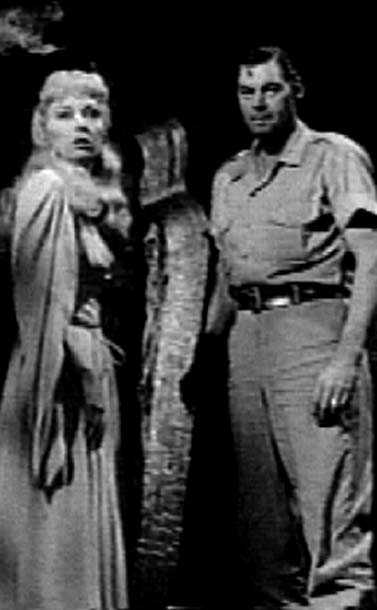
Intrepid explorer Johnny Weissmuller [here for some reason addressed as “Johnny Weissmuller” and not as “Jungle Jim”] and his laugh-a-minute sidekick Kimba the chimp are enlisted by a chick archaeologist to guide her into the forbidden Baku territory guarded by the fierce pygmy warriors [whose ferocity is somewhat obscured by the fact that they dress like Swiss Munchkins in lederhosen] known as the Jungle Moon Men; there she expects to find the mislaid secrets of the ancient Egyptian worshippers of Ra. After shooting a few wild animals and launching the essential subplots involving diamonds and unscrupulous White Hunters bent on plundering the treasures of the hidden lands, they stand presently before the portals of a lost city; within whose catacombs, they discover, a blonde goddess surrounded by Egyptian production design awaits to drug and mesmerize their party and toss them into her stinking dungeons. When an earthquake brings the city down about them and the priestess of the Moon is forced from her hidden chambers into daylight, will the sun-god wreak a terrible vengeance? Stay tuned.
Speaking Parts. [Atom Egoyan, 1989.]
A strange and complex story about a laundry woman [Arsinée Khanjian] in a fancy hotel who has developed a romantic obsession for a janitor [Michael McManus] who works as an extra in motion pictures: she rents the movies in which he has appeared, and watches all his scenes; even though he’s never had a speaking part. This changes abruptly when the cast and crew of a movie in production arrive and he leverages an affair with the writer into a more substantial role; at least until he has to choose between saving his life and ruining hers. — Mainly this is about the twisted postmodern alchemy that has effected the transmutation of video into reality: the most powerful principal character [the inevitable Evil Producer] appears only on a videoconferencing screen, the subject of the film-within-a-film [the writer’s dead brother] is seen only on tape, a crucial suicide by a hotel guest is witnessed only by surveillance cameras, the writer and the actor engage in videophone sex, and the charming Arsinée and her wouldbe lover meet only once [and then of course do not speak.] — But [as always with Egoyan] it is simultaneously about much else: freedom, mortality, the creative anxiety of the artist, the curious purity of unrequited love. — Meanwhile his latest feature [
Felicia’s Journey] hangs in limbo between a halfhearted theatrical run and the video release that will give me a chance to see it; doesn’t anyone else care what a genius this guy is?
The Haunting. [Jan De Bont, 1999; written by David Self.]
Unprincipled [well; maybe just misguided] psychologist Liam Neeson recruits three subjects [Catherine Zeta-Jones, Lili Taylor, Owen Wilson] for what he claims is a study of the causes of insomnia; when they arrive at the site of the experiments and discover it to be the largest and most obviously haunted Gothic mansion in the history of the world, even these exemplars of naivete immediately discern that he is actually interested in the causes of mad gibbering terror. But who really is experimenting on whom? and how about those filmy nighties?
Mahler. [Ken Russell, 1974.]
Fellini in the third person: the composer, returning from America to Vienna, travels upon a train with his wife; the two of them take turns lapsing into surrealistic flashbacks which recapitulate his struggle to succeed and her remorse at her own selfeffacement. — E.g.: a female figure wrapped in mummy’s bandages writhes about a rocky beach as she struggles to emerge from a chrysalis — emerging, she inchworms up to a stone visage resembling that of Mahler and kisses it; a shrouded female shadowfigure follows Mahler through an adoring crowd [I think this is a quote from Magritte]; Mahler imagines his own funeral, his face screaming silently through a window in his coffin as his wife dances obscenely atop it — an urn emerges from the crematorium with a couple of staring eyeballs posed upon the ashes; his wife responds to this relation with a flashback of her own from which Mahler [in a nested flashback] recalls visiting his colleague Hugo Wolf in the asylum — writing music furiously stark naked in his cell — wiping his ass upon his composition — returning to her flashback, she indulges herself in a ritual burial of her own music [this construction is, strictly speaking, illegal, as a point of film grammar: it reminds me of the old Steven Wright joke about getting busted for walking in someone else’s sleep]; and Mahler’s approach to Valhalla to petition the goddess Cosima Wagner for acceptance — he carrying an enormous Star of David, she [with whip in leathers, very Ilsa of the SS] posed before a huge sword stuck in the ground behind her like a cross — he jumps through burning hoops, takes a sledgehammer and trashes his Star as she goosesteps in the background, poses before the Sacred Heart as she throws knives at him, slays [reluctantly] a firebreathing dragon in a cave, emerges with its pig’s-head and eats it from a platter, and sings with her a duet [to the tune of the
Ride of the Valkyries] celebrating his renunciation of the religion of his fathers as they perch upon the swordlike cross and gold coins rain down upon them. — Indescribable; incredible. — Robert Powell plays Mahler; Georgina Hale plays his wife Alma; Dana Gillespie [obviously more talented than one might have guessed from her carer as a Hammer bimbo] plays Anna von Mildenburg; Antonia Ellis plays Cosima. You can guess who wrote the soundtrack.
Voodoo. [René Eram, 1995. Written by Brian DiMuccio and Dino Vindeni.]
Corey Feldman follows his girlfriend across several time zones and enrolls himself in the university where she is attending medical school; announcing his presence to her, he is dismayed to discover that she is not pleasantly surprised but rather pissed off that he has thus injected himself into the fabric of her school life without prior consultation and may now interfere with vital careerbuilding activities like hanging around the lab letting male medical students hit on her. Rejected, humiliated, and at a loss for a place to live, he takes up residence in the fraternity house of the Voodoo Zombies; complications ensue. — A harmless latenight entertainment, this would require no comment were it not [by uncanny coincidence] almost exactly the story of my school days.
Best trailer of the month: David Arquette and Rose McGowan in a wrestling movie [
Ready To Rumble]. — I’ve been watching a lot of wrestling lately, I rather enjoy it, and I regret having said that politics is as phony as wrestling; because I’ve also been watching a lot of politics lately, and politics is actually much, much phonier than wrestling. — Who would you believe, anyway? Goldberg or George W. Bush?
____________Father Time, Mother Night (1/22/00)